
In Denver, hail accounts for $1,547 of the average $3,040 homeowners premium, according to data the Colorado Division of Insurance collected from 20 carriers and released this February. That means about half of what you pay goes to one peril. The follow-up question is less comfortable: when hail finally does hit your roof, what is your wind and hail deductible? If you think the answer is the $1,000 printed near the top of your policy, read the page again. In much of hail country, the deductible that applies to a storm claim is a percentage of your dwelling coverage, and on an ordinary house that percentage turns into thousands of dollars.
Spring is when this stops being theoretical. Cotality’s 2026 Severe Convective Storm Risk Report, published in March, counted 142 damaging hail days in 2025 against a 20-year average of 122, and found that hail two inches or larger struck more than 600,000 homes last year, more than 235,000 of them in Texas. The same report puts 43.5 million properties at moderate or greater hail risk. If yours is one of them, the next ten minutes with your declarations page are worth more than any coupon you’ll clip this month.
A percentage wind and hail deductible is calculated on Coverage A, not on the damage
The math is simple enough to miss. A percentage deductible multiplies the percent by your dwelling limit, which is the Coverage A line on your policy. It has nothing to do with the size of the claim or what the house would sell for.
Say your Coverage A is $350,000. A 1% wind and hail deductible is $3,500. A 2% deductible is $7,000. Your “all other perils” deductible might still be a flat $1,000, so a kitchen fire or a burst pipe works the way you expect. A hailstorm does not.
Here is what that does to a hypothetical $18,000 roof replacement after a storm, assuming full replacement cost coverage on the roof.
| Deductible on $350,000 dwelling | You pay first | Insurer pays |
|---|---|---|
| Flat $1,000 | $1,000 | $17,000 |
| 1% ($3,500) | $3,500 | $14,500 |
| 2% ($7,000) | $7,000 | $11,000 |
Each payout is just the $18,000 claim minus the deductible. The gap between the first row and the last is $6,000, and that $6,000 comes out of your savings, not the insurer’s. Smaller claims get hit harder in proportion. A $6,500 gutter and siding repair under a 2% deductible pays nothing at all.
Your declarations page shows it, but not where you’d look first

Most people glance at the deductible box on the first page, see $1,000, and stop. On many policies in hail states, that box lists two deductibles: one for “All Other Perils” (AOP) and a second labeled something like “Windstorm or Hail,” “Wind/Hail,” or “Named Storm and Wind/Hail.” The second one is often shown as a percentage, sometimes with the dollar figure in parentheses and sometimes without it. If you only see the percentage, multiply it by your Coverage A limit to get the real number.
Then flip to the list of forms and endorsements near the end of the declarations. This is where a separate wind/hail deductible endorsement usually sits, along with anything that changes how your roof is paid. The NAIC’s consumer guidance makes the same point plainly: some policies carry separate deductibles for wind or hail, or for specific parts of the house such as the roof, and the way to know is to read the policy or ask. If you find an endorsement mentioning roof surfacing, a roof payment schedule, or actual cash value for the roof, keep reading, because that one matters more than the deductible.
There’s one more detail almost nobody mentions. Many homeowners policies raise Coverage A automatically each year through an inflation guard so your limit keeps up with construction costs. That’s good for a total loss, but it also raises the dollar amount of a percentage deductible without anyone telling you. Using a hypothetical 4% annual bump, a $350,000 dwelling limit grows to about $425,829 in five years, and the 2% deductible quietly climbs from $7,000 to $8,517. Check the number every renewal, not once.
An actual cash value roof can wipe out a percentage deductible claim
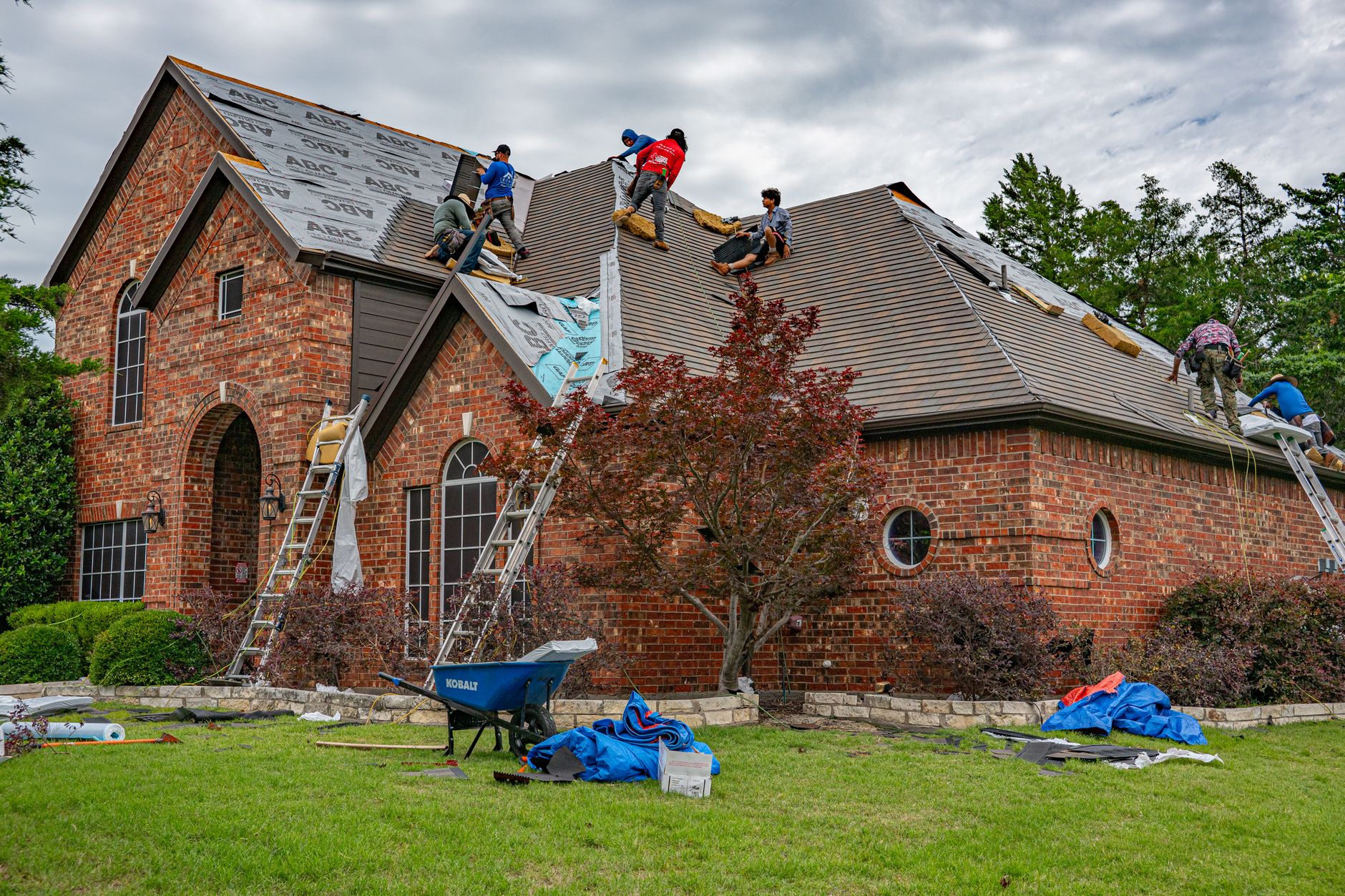
The NAIC explains the two ways a roof claim gets settled. Replacement cost pays to repair or replace the damage without subtracting depreciation. Actual cash value pays the depreciated amount, based on the roof’s condition, its age, and how long that type of roof normally lasts. In the NAIC’s own example, two families each have $15,000 in roof damage and a $1,000 deductible. The family with replacement cost gets $14,000. The family with actual cash value, after $10,000 of depreciation, gets $4,000.
Now stack that on a percentage deductible. Take the same $18,000 roof on our $350,000 house and assume the insurer depreciates the 12-year-old roof by 60% (a hypothetical figure, since the actual percentage depends on the policy and the roof). The actual cash value of the damage is $7,200. Subtract a 2% deductible of $7,000 and the check is $200. Under a 1% deductible it would be $3,700. You still need a new roof, and you’re paying roughly $17,800 of it yourself.
This is the combination I’d hunt for first, because it rarely announces itself. An ACV roof endorsement can arrive as one line in a renewal packet that nobody reads closely. If your policy has an ACV roof endorsement and a 2% wind and hail deductible, your hail coverage on that roof is close to decorative until the roof is replaced.
Raising or lowering the deductible is a breakeven problem
Whether a higher deductible “pays” comes down to two numbers: how much premium you save each year, and how much more you’d pay out of pocket per claim. Divide the second by the first and you get the number of claim-free years it takes to come out ahead.
Suppose, hypothetically, your insurer quotes $280 a year less for a 2% deductible than for 1% on the $350,000 house. The extra exposure per claim is $3,500 (the gap between $7,000 and $3,500). Divide $3,500 by $280 and you get 12.5 years. Put another way, the 2% option wins if you expect a wind or hail claim less often than about 8% of years, which is once every 12.5 years. Over a decade you’d pocket $2,800 in savings, and a single claim in that decade would cost you $3,500 more than the 1% policy, so one hailstorm erases the lot.
Where you live changes the answer. On the Colorado Front Range, the state’s own data shows hail driving about half the premium, which tells you insurers expect to pay hail claims there often. If you expect a hail claim more often than once every 12.5 years, the $280 discount is a bad trade, and you’d want the 1% deductible or a much bigger price gap. In a low-hail area the same $280 can be easy money.
Your cash matters too. A 2% deductible is only a bargain if $7,000 (or $8,517 a few years from now) is sitting somewhere you can reach after a storm. If it isn’t, the cheaper premium is a loan you’ll have to take out at the worst possible moment. Our guide on how much to keep in an emergency fund covers where that money should live, and it’s worth sizing the fund to your actual wind and hail deductible instead of a generic three months of expenses.
The cheapest way to shrink hail risk is often the roof itself
Deductible shopping only moves the numbers a little. The roof moves them a lot. The Colorado Division of Insurance estimated that hail mitigation, such as an impact-resistant roof, could save homeowners an average of $82 to $387 a year across the 11 counties it studied. When you’re due for a new roof anyway, ask your insurer in writing what premium credit an impact-rated roof earns, whether it changes the roof settlement from actual cash value back to replacement cost, and whether it changes the deductible options you’re offered. Those three answers together can be worth more than any deductible tweak.
If you’re reviewing coverage more broadly, our rundown of the types of insurance you actually need puts homeowners coverage in context. For this spring, though, the job is narrow: find your wind and hail deductible in dollars, check whether your roof is on actual cash value, and run the breakeven on the premium quote before you change anything. How these rules apply depends on your policy, your state and your home, so a licensed insurance agent or your state insurance department can confirm what your coverage will actually pay.
Sources: Colorado Division of Insurance, NAIC, Cotality

[…] If you already have a hurricane deductible on your homeowners policy, the earlier guide to wind and hail deductible percentages explains how that part of a storm claim works, and the broader rundown of the types of insurance […]